
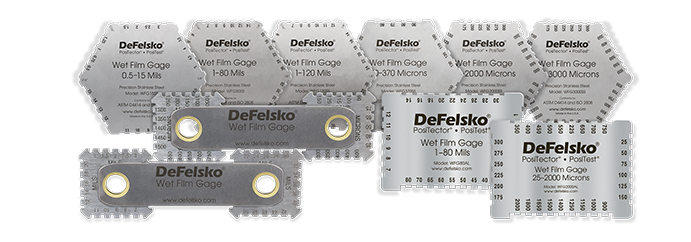
Measuring coating thickness during application is one of the easiest ways to prevent rework and avoid coating failures. This article explains how to calculate, measure, and verify wet film thickness (WFT) so applicators, inspectors, and specifiers can confirm the correct film build before the coating cures. DeFelsko offers a range of wet film thickness gages—including 8-sided, 6-sided (hexagonal), and economical credit card-style options—designed to support these measurements in the field.
If a coating is going on too thin or too thick, you want to know immediately—not after the film has dried. Measuring WFT in real time allows the applicator to make quick adjustments: spray technique, gun settings, speed, overlap, and more.
Fixing thickness problems after cure typically means extra labor, potential contamination of the surface, and possible risks to adhesion and overall coating integrity. A 30-second WFT check during application can prevent hours of rework later.
Note: “Reducer” and “thinner” are used interchangeably in this article to describe added solvent that increases liquid volume without contributing solids.
These charts show required WFT for common coating scenarios. Always verify specific project requirements with current contract documents and manufacturer data sheets.

Notice the pattern: Adding 10% reducer requires roughly 10% more WFT to achieve the same DFT. If applicators don't account for this, the cured film will be thinner than specified—potentially leading to premature coating failure.
If the calculator or charts above were used, this section explains the math behind those numbers.
A wet coating contains solvents and/or water that evaporate during drying and curing. As those volatiles leave the film, thickness decreases. Wet Film Thickness (WFT) is typically thicker than what remains after cure (DFT).
The relationship between WFT and DFT depends primarily on the coating's percent solids by volume—the portion of the liquid coating that actually remains as solid film after all volatiles evaporate. This information is typically listed on the coating manufacturer's Technical Data Sheet (TDS).
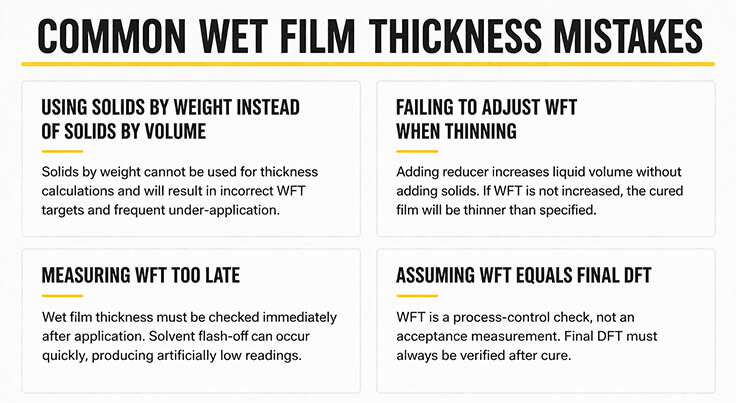
Use solids by volume for WFT/DFT calculations. Solids by weight measures mass, not volume, and cannot be used for accurate thickness conversions. Using the wrong value can result in significant thickness errors.
This section shows the formulas used in the calculator and explains when to use each one.

Formula 1: Coating Applied As-Supplied (No Reducer)
When the coating is applied straight from the container with no thinning:
WFT = DFT / (SV / 100)
Where:
• WFT = wet film thickness
• DFT = desired dry film thickness
• SV = solids by volume (%) of the coating as supplied
Example:
Target DFT = 100 µm, Solids by volume = 60%
WFT = 100 ÷ (60/100) = 100 ÷ 0.60 = 167 µm
Formula 2: Reduced Coating (With Reducer Added)
Adding thinner/reducer increases liquid volume but typically adds no solids. The mixed material has a lower effective solids by volume, so a higher WFT is needed to reach the same DFT.
WFT = DFT * (1 + t) / (SV / 100)
Where:
• t = fraction of thinner added relative to coating volume (Example: 10% thinner = 0.10)
Example:
Target DFT = 100 µm, Solids by volume = 60%, 10% reducer added
WFT = 100 × (1 + 0.10) ÷ (60/100)
WFT = 100 × 1.10 ÷ 0.60 = 183 µm
Important: These calculations assume that the thinner contributes no solids by volume, which is true for most common reducers. If an additive that contains solids or resin is added, the results may differ.
An applicator needs to reach a dry film thickness (DFT) of 150 µm (6 mils) using an epoxy coating that is 65% solids by volume. To improve spray flow, 10% reducer was added.
The Calculation:
WFT = 150 × (1 + 0.10) ÷ (65/100)
WFT = 150 × 1.10 ÷ 0.65
WFT = 165 ÷ 0.65 ≈ 254 µm
Result: The applicator must aim for roughly 250–260 µm on the wet film comb to ensure the 150 µm dry target after cure.
Adding reducer increases liquid volume without adding solids, which means more wet paint is required to achieve the same dry film thickness.
If this adjustment is not accounted for, the solvent flashes off and the remaining film will be thinner than specified—potentially leading to pinholes, reduced corrosion protection, or premature coating failure.
This is why measuring WFT during application is especially critical when working with reduced coatings.
Now that the target WFT is known, here's how to check it during application.
The standard method for wet film thickness measurement is a wet-film comb (notched gauge). It's simple, inexpensive, and gives an immediate thickness range during application.
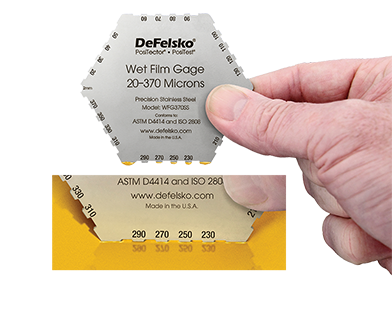
A wet-film comb is a flat aluminum, plastic, or stainless-steel plate with calibrated notches of varying heights.
How to Use:
Example: If the 8 mil notch has wet paint on it, but the 10 mil notch is clean, your WFT is between 8–10 mils.
Notched gauges are not precision instruments, but they are useful for determining approximate WFT—especially on parts where size or geometry prevents other approaches.
WFT checks are extremely useful for process control, but they are still an estimate of final DFT. Actual results can vary due to several factors:
For critical applications—particularly structural steel, immersion service, or specifications with tight DFT tolerances—always confirm final DFT after cure using appropriate dry film thickness gauges and applicable standards.
Both measurements serve different purposes, and both are necessary for quality assurance.
Frequently Asked Questions
Where do I find solids by volume?
Solids by Volume are typically listed on the coating manufacturer's Technical Data Sheet (TDS), often in a table showing physical properties.
Can I use solids by weight instead?
No. Solids by weight cannot be substituted for solids by volume in WFT/DFT thickness calculations. The two values measure different properties and will produce incorrect results if confused.
Does thinning always reduce DFT?
If you apply the same WFT, thinning generally produces a lower DFT because the solids are diluted by additional solvent volume. To reach the same DFT with a thinned coating, you need a higher WFT than you would with unthinned material.
What if the WFT reading is off-target?
Adjust spray technique, gun settings, speed, or overlap immediately. That's the entire point of measuring WFT—catching problems while they're still easy to fix.
How many WFT readings should I take?
Follow project specifications. As a general guideline, take readings in multiple locations across the coated area to account for application variation. Areas near edges, corners, and welds often require additional attention.
Measuring wet film thickness during application is a simple, effective way to prevent costly rework and coating failures. Whether using the calculator, referencing the charts, or working through the formulas manually, the goal is the same: confirm that enough material is being applied to achieve the specified dry film thickness.
Key takeaways:
• Always use solids by volume (not by weight) for calculations
• Account for reducer/thinner when calculating target WFT
• Measure WFT immediately after application while adjustments are still easy
• Verify final DFT after cure for critical applications
• When in doubt, consult the coating manufacturer's Technical Data Sheet
Ready to measure? Explore DeFelsko wet film thickness gages designed for fast, reliable WFT checks during application.
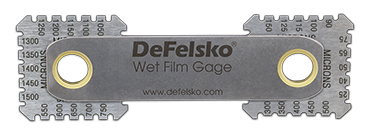
8-Sided
• Reusable
• Durable stainless steel construction
• 40 notches for superior resolution
• Two-sided—microns and mils
• Best Suited for pipelines and other rounded parts
• Includes Certificate of Accuracy
Choose when: higher precision is required or measuring on curved/irregular surfaces
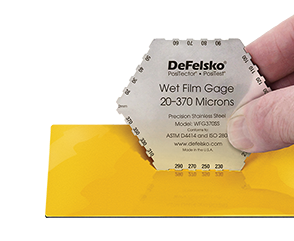
6-Sided
• Reusable
• Durable stainless steel construction
• Select from 6 measurement ranges in microns or mils
• Metric versions include a notch for confirming 2 mm edge radius (ISO 8501-3)
• Imperial versions include features for confirming 1/16” and 1/8” edge radius and edge chamfers conforming to NACE SP0178, PA11
Choose when: a general-purpose gage is needed with added surface prep verification
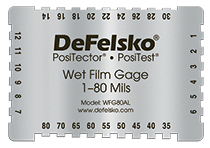
4-Sided
• Economical aluminum construction
• Can be discarded, kept as a record of film thickness, or cleaned and reused
• Select from microns or mils
• Sold in packs of 10
Choose when: cost matters, multiple inspectors are involved, or documentation/traceability is useful
.png)


