Determining both the quantity and size of dust particles on a surface can be an important step before the application of a protective coating. Dust is one of a number of contaminants that can be detrimental to a coating’s effectiveness and lifespan, by reducing adhesion and potentially retaining moisture which can lead to corrosion. Dust can be of particular concern on blast-cleaned surfaces.
The dust tape test described in ISO 8502-3 is a simple and widely used method for assessing loose dust on prepared steel surfaces prior to coating. While the test itself is easy to perform, the evaluation and reporting of results are often misunderstood. This field guide explains, step by step, how to properly perform the dust tape test and, more importantly, how to grade and report the results in accordance with ISO 8502-3. By focusing on visual comparison, consistency, and correct interpretation of the reference images, inspectors can achieve more reliable and defensible dust ratings in the field.
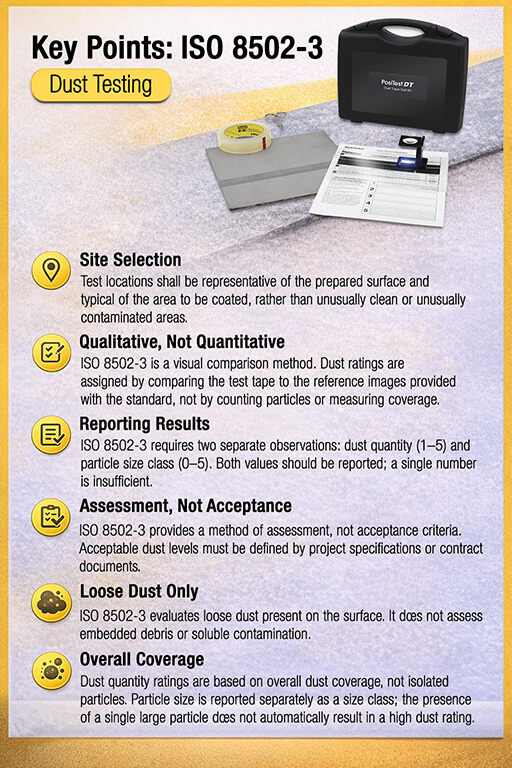
1. Site Selection - Select a test location representative of the prepared surface and typical of the area to be coated. Avoid isolated features such as edges, corners, weld spatter, visible oil or moisture, and areas disturbed by handling or foot traffic. The selected area should reflect the general cleanliness of the surface, not the best- or worst-looking spot.
2. Tape Selection - Use transparent adhesive specifically intended for use with ISO 8502-3. Before testing, remove and discard the first three turns of tape from the roll. Cut a piece of tape approximately 20 cm (8 in.) long.
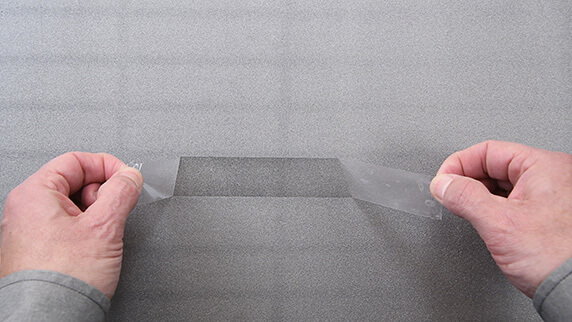
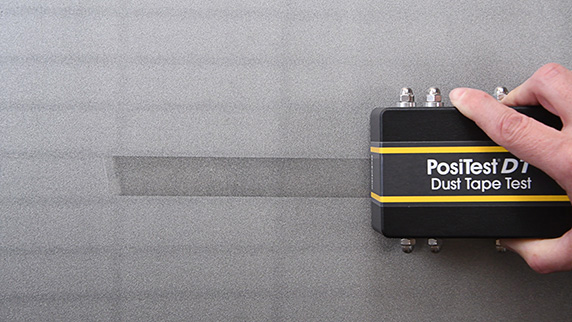
3. Application - Press approximately 15 cm (6 in.) of freshly exposed tape onto the surface under test using firm, uniform pressure applied with either a thumb or a tape roller. Move across the tape three times in each direction at a constant speed, with each stroke taking approximately 5–6 seconds.
Remove the tape from the surface and press it onto the transparent display board.
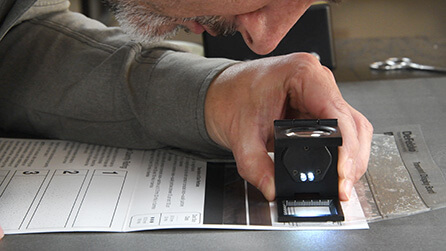
4. Preparation for Evaluation - Place the Transparent Display Board over the black, white, or two-tone background on the Dust Test Comparator Display Board, selecting the background that provides the greatest visual contrast. The test tape is then visually compared to the dust rating reference images provided in ISO 8502-3 to determine dust quantity and particle size class.
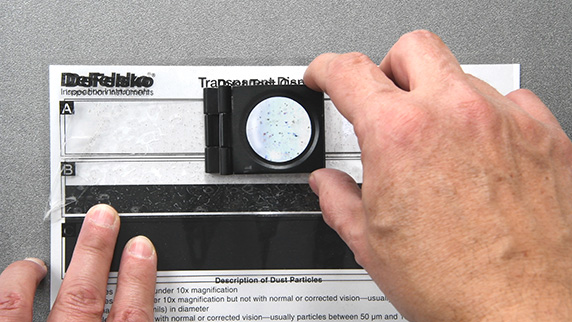
After the test sample has been collected and mounted, the quantity and particle size of dust are assessed by visual comparison. To ensure consistent and reliable results, the evaluation should be carried out under suitable and repeatable conditions.
For each surface type, conduct a minimum of three tests. If any results differ by more than one dust quantity or dust size rating, perform at least two additional tests and report the mean dust quantity rating.
Determine the Dust Quantity
Assess the quantity of dust on the tape by visually comparing it to the pictorial reference images provided in ISO 8502-3 or on the DeFelsko Dust Comparator and Dust Test Report Form. Magnification is not required.
Assign the dust quantity rating that most closely matches the overall appearance of the test tape area. Do not base the rating on isolated particles or worst-case areas. Dust quantity is determined by overall coverage, not by counting particles.

Where appropriate, intermediate half-step ratings may be used to provide a more detailed assessment (e.g. report 2.5 for a test result that falls between grades 2 and 3).
Determine the Particle Size Class
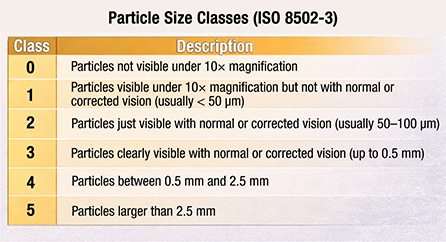
Determine the particle size class by visually comparing the predominant dust particles observed on the test tape to the particle size classifications provided in ISO 8502-3 or on the DeFelsko Dust Test Comparator. For smaller dust particles use a 10x magnifier to determine the appropriate size classification.
Assign the numerical particle size class (0–5) that most closely corresponds to the appearance of the particles present. Particle size classification is independent of dust quantity and is reported separately.
Particle size classes are defined in ISO 8502-3 using visual descriptors, with approximate dimensional ranges provided for guidance. These dimensional values are descriptive and do not require direct measurement of individual particles.
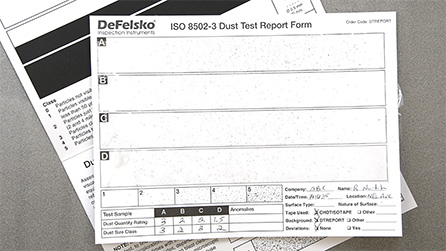
The test report should include the following information:
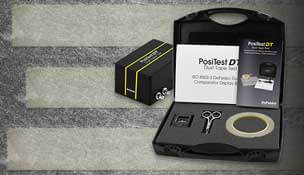
The ISO 8502-3 Dust Test Report Form included as part of the PosiTest DT Dust Tape Kit can be used to record all of this information and allows you to retain the actual test tape used.
ISO 8502-3 offers a simple, effective method for assessing loose dust on prepared steel surfaces, but consistent results require proper execution and correct interpretation. Understanding that the test is a visual comparison method, selecting representative locations, and reporting both dust quantity and particle size class ensures the standard is applied as intended. When performed under consistent conditions and documented correctly, ISO 8502-3 provides a reliable way to evaluate surface cleanliness before coating and communicate results clearly among all parties.
Two inspectors may assess the same surface and arrive at different dust ratings because ISO 8502-3 relies on visual comparison rather than direct measurement. Differences in lighting, viewing angle or distance, background contrast, test location selection, and individual interpretation of the reference images can influence the assessment. When the procedure is applied consistently and under similar conditions, results are generally repeatable, but some variation is inherent in any visual evaluation method.