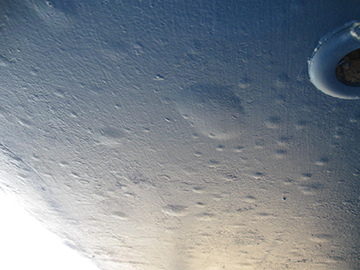
Soluble salts left on a surface before coating are a leading cause of premature coating failure. Although these contaminants are often invisible, they can significantly reduce coating life and increase maintenance costs.
These salts attract moisture, promote underfilm corrosion, and can cause blistering or loss of adhesion after painting. Because common surface preparation methods, such as abrasive blasting or power-tool cleaning, do not reliably remove soluble salts, verification prior to coating is often critical to long-term coating performance.
Three different inspectors test the same blasted steel surface using the Bresle method. One reports 22 µS/cm, another reports 28 mg/m2, the third reports 2.5 µg/cm2. All three believe the surface is acceptable. Which one is correct?
Situations like this are common because soluble salt testing is often misunderstood. The Bresle method does not directly measure the amount of salt on a surface, it only instructs inspectors in a method to collect samples from the surface. Other standards and calculations must be followed to return meaningful results from these samples.
To add to the confusion, some test methods measure the concentration of individual salt ions on a surface. While these methods are also testing for surface contamination, they are reporting a completely different value, and cannot be compared directly to the results of a conductivity test.
To ensure consistent and meaningful results it is important that all parties involved understand the relevant standards, the units being used in a specification, and the best practices for measuring and reporting soluble salts.
ISO 8502-6 and ISO 8502-9 work together to provide a standardized, repeatable method for assessing soluble salt contamination on steel surfaces prior to coating. For more information on how to use these methods, read the article Measuring Soluble Salts in Accordance with ISO 8502-6 and ISO 8502-9—the Bresle Method.
ISO 8502-6 specifies how soluble salts are removed from the surface. A defined volume of deionized water is placed in contact with a known surface area, using a patch or cell, to dissolve water-soluble contaminants.
The deionized water is drawn in and out of the patch, and then left for a specified dwell time, before being removed for testing.
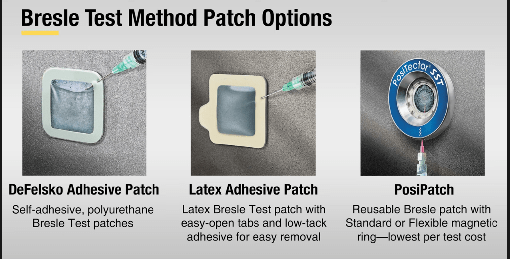
The DeFelsko PosiPatch, Adhesive Patch, and the Latex Adhesive Patch all conform to ISO 8502-6.
ISO 8502-9 specifies how the extracted solution is evaluated. The conductivity of the solution is measured using a temperature compensated conductivity meter.
The surface density of salt is calculated using the known conductivity value of different types of salt, the volume of water used in the test and the surface area the water was in contact with.
The PosiTector SST interchangeable probe complies with ISO 8502-9 and guides users through the ISO 8502-6 and 8502-9 test methods.
Summary: ISO 8502-6 defines how salts are extracted; ISO 8502-9 defines how conductivity is converted into a comparable surface contamination value.
Salt is a broad category of natural chemical compounds, which can have different properties and conductivity values. A surface to be coated will typically have a mix of different salts, each of which can have a different effect on conductivity.
The method defined by ISO 8502-6 and ISO 8502-9 does not identify the specific composition of salts on a surface. Instead, the calculation assumes a contamination profile based on seawater. An influential article by Åke Bresle (the namesake of the method) proposed using a conductivity constant of 5 kg·m⁻²·S⁻¹. This value was derived directly from the relationship between conductivity and the total dissolved mass of salts in seawater, which serves as the reference model for soluble salt contamination. Since residues from seawater and inland road/sea salts are the predominant sources of contamination, this assumption remains valid for the vast majority of applications.
Other constants have been proposed based on assumptions that a surface contains only a single salt type (such as NaCl) or a specific ion (such as Cl⁻). These alternatives are occasionally specified for particular applications or comparison, but ISO 8502-9 specifies a constant of 5 kg·m⁻²·S⁻¹ for general industrial surface preparation.
To answer this, we must look at where the salts come from. For the vast majority of coating projects, the specific ion composition does not matter because it is predictably consistent. Most soluble salt contamination on steel structures stems from two primary sources: marine air and de-icing salts. Airborne salts from the ocean can travel significantly inland, and roads and bridges are frequently treated with rock salt. Both sources deposit a mix of salts dominated by Sodium Chloride (NaCl).
Because these two sources account for the overwhelming majority of surface contamination, the mixture of ions on a steel surface is rarely a mystery—it is almost always a chloride-heavy mix similar to seawater. This consistency is exactly why the ISO 8502-9 calculation works: it assumes a "standard" mix of salts (based on seawater) that reflects reality for most industrial painting projects.
However, there are exceptions where the contamination source does not fit this profile. In these cases, a general conductivity test might be misleading. For example, structures near coal-fired power plants or chemical processing facilities may be contaminated by sulfates or nitrates rather than chlorides. Additionally, if a surface is washed with highly conductive cleaners or rust inhibitors, a conductivity test might show a "fail" due to the harmless residue of the cleaner rather than the presence of detrimental corrosion salts.
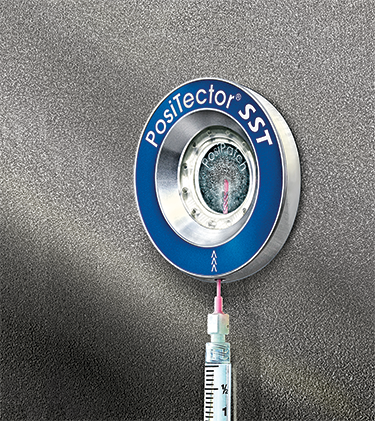
While the type of ion plays a major role in chemical corrosion, the total concentration drives physical blistering.
Chemical Attack (Corrosion) Specific ions attack steel with different levels of aggression. Chlorides are small, highly mobile ions that penetrate the steel's passive oxide layer, leading to rapid pitting corrosion. Sulfates, common in industrial zones, react with steel to form corrosion products that expand and crack the coating from underneath. From a strict corrosion standpoint, a specific amount of chloride is more dangerous to the steel than the same amount of a less aggressive salt (like a carbonate).
Physical Attack (Osmotic Blistering) In contrast, osmotic blistering is driven by concentration, not chemistry. Soluble salts left beneath a coating are hygroscopic and draw moisture through the semi-permeable paint film via osmosis. The force of this draw (osmotic pressure) is determined by the concentration of dissolved particles, regardless of which specific ions are present. Therefore, a high conductivity reading indicates a high concentration of dissolved salts and a correspondingly high risk of blistering, even if the ions present are not chemically aggressive.
Because osmotic blistering is driven by total concentration, the ISO 8502-9 method is an excellent predictor of blistering risk regardless of salt type.
Furthermore, it acts as a conservative safety net for corrosion. If the calculated surface density is low enough to meet a strict specification (e.g., < 20 mg/m²), the concentration of any individual aggressive ion will inevitably be even lower. By limiting the total salt level, the standard effectively limits the aggressive ions without requiring complex, expensive, and slow chemical analysis in the field. This "catch-all" approach ensures that if a surface passes the Bresle test, it is generally safe for coating.
Soluble salt results are commonly reported in one of three ways:
Project specifications will typically provide acceptance criteria in one of these units. Understanding what each unit represents, and knowing which conversions are possible, is essential to interpreting and reporting test results correctly
Conductivity is the simplest value to report when testing using the Bresle method. After performing the extraction process defined in ISO 8502-6, the extraction liquid can be measured using a conductivity meter, providing a result in µS/cm or an equivalent unit.
More commonly, specifications will be based on the maximum concentration of salts that can be present on the surface, expressed using a surface density unit. Converting conductivity readings to surface density requires calculation using the extraction volume, test area, and the conductivity of the salt present on the surface.
Note: Some specifications require ion-specific measurements (e.g., chloride concentration in ppm). These measurements cannot be calculated from conductivity readings, and other test methods must be used.

To calculate the surface density of soluble salts (ρA) in mg/m2, ISO 8502-9 provides the following equation:
ρA = c ⋅ 10 ^ 2 ⋅ V ⋅ Δγ / A
Two of these parameters (V and A) are taken from the specifics of the test procedure and tools used, and can be different based on the manufacturer and model. ∆γ is the result taken from the conductivity meter.
As discussed above (see: How Does ISO 8502-9 Determine What Type of Salt is on the Surface?), the constant c is based on the assumed nature of the salt on the tested surface. ISO 8502-9 recommends using a value of 5 kg·m⁻²·S⁻¹ to represent a standard mix of salts common on surfaces.
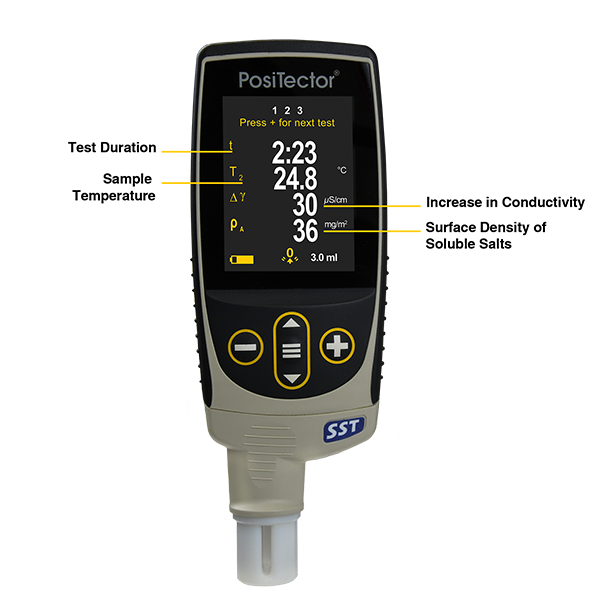
Sample Calculation:
Test Data:
• Conductivity Reading (Δγ): 20 µS/cm
• Extraction Volume (V): 3 ml
• Test Area (A): 12.5 cm2 = 1250 mm2
Assumptions:
Ionic Conductivity Constant (c): 5 kg·m-2·S-1
Apply the Formula:
ρA = (c · 102 · V · Δγ) / A = (5 · 100 · 3 · 20) / 1250 = 30000 / 1250 = 24 mg/m²
Interpretation:
If the Project Specification allows a maximum of 50 mg/m2 prior to coating, this surface passes. If the specification is 20 mg/m2 this surface fails.
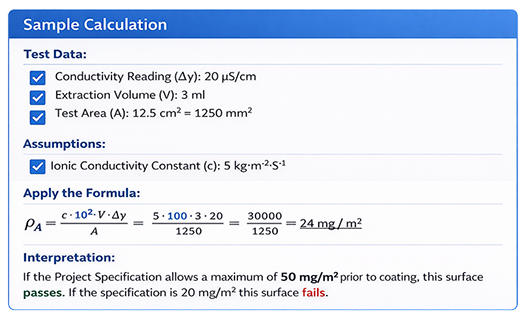
Note: Modern conductivity meters designed for Bresle method testing, such as the PosiTector SST, can automatically perform the calculations shown above. By inputting the extraction volume, test area, and assumed salt type during setup, the instrument will automatically display both the conductivity (µS/cm) and salt density (mg/m2 or µg/cm2) immediately after performing the test.
Surface density of soluble salts is commonly specified and reported in 2 different units: mg/m2 and µg/cm2. These units both measure mass of salt per unit area, just at different scales. Like meters and centimeters, these units can be converted between using a simple multiplication factor.
To convert between units multiply or divide by ten:
For the sample calculation above, if results needed to be reported in µg/cm2, simply divide by 10 to return a final result of 2.4 µg/cm2.
Remember our three inspectors from earlier? Each believed the surface to be within specifications, although each reported in different units: 22 µS/cm, 28 mg/m2, and 2.5 µg/cm2.
With a strong understanding of these three different units, we can perform calculations to make these values easy to compare. After confirming with the first inspector that he used 3 ml of extraction liquid and a test cell with an area of 1250 mm2, we can calculate a surface density of 26.4 mg/m2. For the third inspector, we can multiply her result by 10 to convert to 25 mg/m2.
Now we have three results with the same units: 26.4 mg/m2, 28 mg/m2, and 25 mg/m2. These three readings are within normal measurement variation, and when compared against a project specification of 50 mg/m2, the three inspectors can correctly agree that the surface passes and is ready for coating.
In addition to the test method and calculation, several factors can affect test results. It is important for an inspector to understand how the factors impact measurement results, maintain consistency between tests, and report any deviations from standard practice.
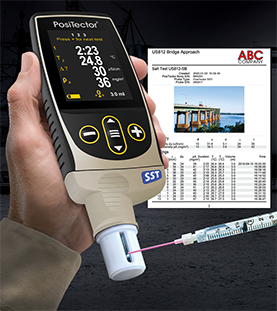
The first step when performing a Bresle method test is to take a blank or background measurement to correct for any contamination that is present in the water or equipment rather than from the surface itself.
Following manufacturer instructions, measure the conductivity of the deionized water being used prior to the test. Once recorded, this blank test reading should be subtracted from the final conductivity reading to measure the change in conductivity of the water after being in contact with the surface (∆γ = conductivity after test – conductivity of blank test).
Typically, a blank test result of 5 µS/cm or less is acceptable for testing. If higher results are seen, rinse the conductivity meter and test implements with deionized water, or use a new bottle of deionized water.
Temperature normalization compensates for the influence of temperature on conductivity readings, so results can be compared accurately and consistently. Electrical conductivity increases as temperature rises because ions move more freely in warmer solutions.
To eliminate this effect, conductivity measurements used for soluble salt testing are normalized to 25 °C, as required by standards such as ISO 8502-9. This adjustment is usually performed automatically by the instrument using a built-in temperature sensor and correction algorithm.
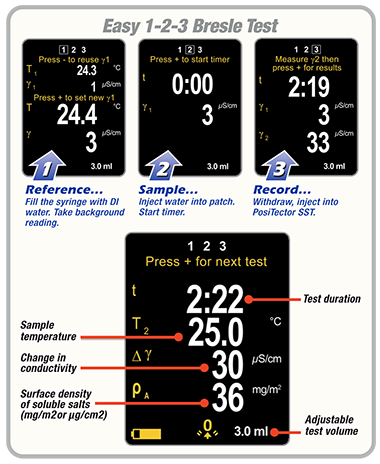
The amount of time the water spends in contact with the surface can affect the amount and types of salt that are extracted. Most instrument manufacturers recommend a 2-minute dwell time as a good balance between practicality and extraction efficiency. Individual standards provide different recommendations for the amount of time that should be used for soluble salt extraction. ISO 8502-6 historically did not require a specific dwell time; the more recent 2020 revision specifies a dwell time of at least 10 minutes. Other international standards (such as SSPC Guide 15) recommend dwell times as low as 90 seconds.
It is important to use the same dwell time when performing multiples tests, and to only compare results between tests performed with similar dwell times. Consult the job specification or standard being used to determine if a specific dwell time should be used, or discuss with interested parties to come to an agreement on the dwell time prior to testing, especially when multiple inspectors will be comparing test results.
After performing the test correctly and calculating surface density, the results must be compared against acceptance criteria. ISO 8502-6 and 8502-9 do not specify the level of salt that is acceptable on a surface; instead, these limits are defined by project specifications or the performance requirements of the coating being applied. There is no universal pass/fail limit for soluble salts. Acceptable levels depend on the service environment, coating system, surface preparation method, and project specification.
Factors that Determine Acceptable Salt Levels
Standards intentionally avoid fixed thresholds, placing responsibility on the specification to define acceptance limits.
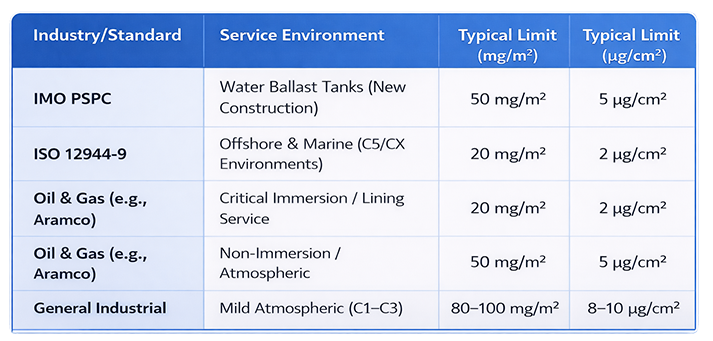
Illustrative examples only. Always verify specific project requirements with current contract documents and manufacturer data sheets before proceeding.
Typical Limits According to Industry Standards
IMO PSPC (Water Ballast Tanks - New Construction)—50 mg/m2 (5 µg/cm2)
ISO 12944-9 (Offshore & Marine - C5/CX Environments)—20 mg/m2 (2 µg/cm2)
Oil & Gas (e.g., Aramco) Critical Immersion / Lining Service—20 mg/m2 (2 µg/cm2)
Oil & Gas (e.g., Aramco) Non-Immersion / Atmospheric—50 mg/m2 (5 µg/cm2)
General Industrial (Mild Atmospheric - C1-C3)—80-100 mg/m2 (8-10 µg/cm2)
Interpreting soluble salt results requires understanding both what the test measures and how results are calculated and reported. The Bresle method measures the electrical conductivity of an extracted solution, not the actual mass or composition of salts on the surface. This conductivity is then converted to surface density using the extraction volume, test area, and an assumed conductivity constant based on typical salt mixtures.
When results are properly temperature-normalized, verified against a clean blank, and reported in the correct units, they provide a reliable and repeatable indicator of soluble salt contamination. Interpreted within the context of the project specification, these results allow inspectors, specifiers, and owners to make informed pass/fail decisions before coating.
Key Takeaways
• Soluble salts can remain on prepared surfaces and are a common cause of premature coating failure.
• Soluble salts cause coating failure via two processes: Chemical Attack and Osmotic Blistering.
• The Bresle method does not measure salt mass; it measures the conductivity of an extracted solution
• ISO 8502-6 defines how soluble salts are extracted from a surface; ISO 8502-9 defines how conductivity is interpreted
• Test results are typically reported in units of surface density, not actual salt composition or ionic concentration
• Conductivity values must be temperature-normalized and verified against a blank test to be meaningful
• Reporting units matter: µS/cm describes solution conductivity, while mg/m² or µg/cm² describe surface contamination
• Converting conductivity to surface density requires assumptions about extraction volume, test area, and salt composition
• There is no universal pass/fail limit—acceptance criteria are defined by the project specification
• Properly interpreted, soluble salt test results provide a repeatable, standardized indicator of surface cleanliness prior to coating